

Cover story · Football
Nobody called.
Two years ago he carried a trombone. Before that he carried the practice scripts. Last fall he threw thirty-five touchdowns and no interceptions, and the people in this building who understand football best are the ones who cannot sleep about it.
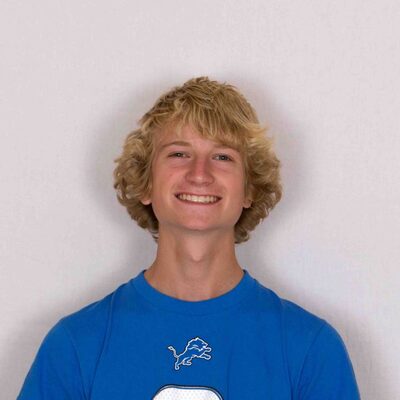
Editor's note: Hudson is a friend of the subject and appears in this story by name. Both facts were disclosed to the adviser before reporting began. — M. Pearce Jr., managing editor
There is a man in a Silverado at the second window at Culver's on Owen Road, on a Tuesday in July, at a quarter past four, and he wants the cheese curds in the shake. He is being told, politely, that this is not something they do. He has no idea who is telling him.
That is not the interesting part. The interesting part is that six other cars came through that window on that same shift, and every one of them knew exactly who was holding the tray, and every single one of them asked the same question.
"Where you going?"
"Like — for college," he said, when I asked him about it. "That's always the question. I have nothing to give them, so it's 'we'll see,' and they come back with 'you'll be fine,' and then I pass them a spoon."
He has said we'll see to roughly forty adults this summer. Nobody has followed up. Not one of them has asked the second question, which is the only question, which is: who has called?
Nobody has called. Not a coach, not a recruiter, not a scout, not a service, not a school. Not once, not ever, to this building or this family. Thirty-five touchdowns, zero interceptions, undefeated, school record, and the number of college football programs that have contacted Fenton High School about Nick Mansour is zero.
This article is about how that happened, and it is longer than anything this paper has run in my three years here, because every time I thought I had the answer somebody handed me a better one.
Twenty-four months ago he was a band kid
I need people to sit with this, because I have watched this school get comfortable with a thing that is not normal.
Twenty-two months ago, in the autumn of 2024, Nick Mansour was playing trombone in the Fenton High School marching band. Wool uniform, forty-degree Friday nights, third row of the low brass, standing on the track at Fenton football games because that is where the drill put him.
I want to be careful with the next part. In this building "band kid" functions as a way of saying "not an athlete," and those two ideas have gotten welded together in a way that does him no favours and is also just wrong on the facts.
He was the best musician in this school. Not one of the best. First chair trombone from his freshman year and never once displaced. John Galvin, who shared the section leadership with him and has been his friend since ninth grade, wanted a distinction on the record before he would say anything else:
"We split it. My contribution was filing forms and raising my voice, which covers most of what the job is. His contribution was being the best musician in the section, which he plainly was, and which required no election because that sort of thing does not go to a vote."
Andrew Perkins has run this band for twenty-six years and would not rank his students, which I should have anticipated and did not. "I'm not going to sit here and put my kids in order for a newspaper. That's not a thing I do."
What he would say was this: "Both instruments. That's the part that isn't normal. Around here you are a brass kid or you are a piano kid. He isn't either one, he's just —" and then he did the thing where he stops and starts the sentence over. "I've sent kids to Interlochen. I'll leave it there."
Then, after a pause, the part I have not been able to put down since:
"And nobody in this school ever gave him one thing for it. No assembly. Nobody stopping him in a hallway. He was the best in this building at something for three years and it bought him nothing. Then he threw a football and there's a poster of him at the Wing and Grill." He caught himself. "Do not run that as me taking a shot at football. Print it as me complaining about us."
From behind a sousaphone he watched Ben Haijcar run the offense. By the next August the job was his. Eleven months after that he owned the school record.
I asked him about the band thing. What he said was, "There are about four things Tommy does better than me."
Tommy Quinn, asked to confirm: "That's insane. Coming from him, that is a deranged sentence. Music I need seven days with, he reads cold off the page." This is a pattern and we will come back to it.
His case is still on the third shelf with his name taped to it. Perkins has not moved it. Asked why, he said, "Because it's his shelf."
One person has watched him play music longer than anybody in this district, and she does not live in it. Barbara Kettunen taught him piano in her front room in Linden from the age of seven until the spring of his sophomore year. Forty-five minutes, Thursdays. I called her because Perkins told me to.
"Second week of September he walked in, and he was awful," she said. "Everyone's terrible. He was terrible in a specific way — he'd play something wrong and then sit there and work out why it was wrong instead of asking me. Which is very annoying when you're paid by the hour, and is the entire reason he got good."
She stopped teaching him in April 2025, about six weeks before his first first-team rep at quarterback.
"He called me himself. Not his mother — him. Told me something at school was starting up in spring and he wasn't going to keep paying for lessons he'd show up late to." A pause. "I said what thing. He said football. I laughed at him. I want that in there. I laughed at him on the telephone and I have thought about it a great deal since."
She went to the Linden game last October, sat with her daughter, and did not enjoy it.
"I spent the whole thing worried about his hands."
"It hasn't really registered for me either. Somebody says 'the quarterback' and I turn around to see who they mean. That genuinely happens, more than once. I look around." Nick Mansour
How he actually got into this building
Here is the story this school tells, in full: he wrote a clever article, Coach Setzke read it, Coach Setzke called him in, and two years later he was the quarterback.
I have told that story. I have printed it, in this newspaper, under my own name. It is wrong in every part that carries weight, and I found that out three weeks ago while reporting this, and it is the single most uncomfortable thing in this article.
Setzke never read the column.
I asked him about it in the one exchange he agreed to have with me, which came through Coach Shaffer and lasted about ninety seconds. He said he had heard there was an article. He said somebody mentioned it in a hallway. He said he does not read the school paper. I asked whether he had read it since. He said, "Why would I read it now."
So what did open the door? It took me eleven days and a screenshot to find out, and the answer is the least romantic thing in this entire story.
He asked. Three times. Over fourteen months. And he was ignored for thirteen of them.
The first text went out in October of his freshman year. He was fourteen. He had charted every Fenton game that season, unasked, for nobody, and he told Setzke there was something fixable on third down and offered to show him. The last line of it is "I'm not asking to play, I just want to help."
No reply.
The second went out in October of his sophomore year, four days after the column ran. It apologises. An unpaid fifteen-year-old wrote a nine-hundred-word piece of analysis that was completely correct and then apologised in writing to the man it was about, in case it had come across as a know-it-all.
No reply.
The third went out on December 12, 2024. He told Setzke he had charted all nine games — personnel groupings and snap counts for every opponent, by down and distance — that it came to forty-one pages, that nobody had asked him to do it, and that Setzke could simply have it. No conditions. He did not have to be let near the team.
The line in it that I keep going back to is: "I just don't want to have done it for nothing."
Two days later Setzke replied with two words: Send it. Nine days after that, he told him to be in the field house on January 6 at six in the morning, and added, unprompted, this is not a tryout.
Setzke, in his ninety seconds, was completely unembarrassed about why he said yes.
"He'd already done the work. That's the thing. It wasn't the persistence — persistent kids are a headache. He sent me forty-one pages I didn't ask for and didn't have to pay for, and it was good." Then: "You know what any assistant costs? I had a kid who wanted to count personnel groupings for free and do what he was told. I'd have been an idiot."
Did he think, at any point that winter, that he might have a player?
"No. Why would I."
The job
The title, on the one piece of paper where it exists, is student personnel assistant. No stipend. No letter. No jacket. Not in the sideline photograph.
What it meant in practice: counting personnel groupings off opponent film, every opponent, every week. Charting snap counts and tendency. Printing and collating the practice scripts twice a week. Cutting whatever clips Shaffer wanted, usually the night before. Carrying things. Setting up. Breaking down.
Getting water.
I asked him about the water directly, because I wanted to know whether it bothered him. He said "it wasn't a big deal," which is a sentence people use about things that were somewhat of a deal, and then he changed the subject, which he did to me nine separate times across three weeks.
Inside the team he was treated the way managers are treated. I want to be precise here, because there is a version of this article that turns into a bullying story and that version would be false. Nobody was cruel to him. He was ignored. The players thought he was lame in a vague, unmalicious, high-school way. He knew he was cooler than they thought he was. Neither of those facts changed anything.
And every single one of those players is now in his huddle.
Kevin Lack catches more of his passes than anyone alive and is not sentimental about anything. "I'm not going to sit here and act like I knew. He was the guy with the papers. I said maybe four words to him that whole spring."
What changed? "He got good. That's it. That's the whole thing. People want there to be more."
I asked Mansour whether the people who ignored him then treat him differently now. He said, "Of course they do." I asked whether that bothered him. He said, "Why would it bother me, they were right." I asked him what he meant by that and he changed the subject for the fourth time.
Here is what I think, and it is a reporter's opinion in an article and I have flagged it as one: he printed the scripts. That is why he knew the entire install in April, before he had taken a snap, a fact the coaching staff did not put together until months afterward. The unpaid job that everyone in this story treats as a footnote is the reason there is a story at all. Take away the boy standing behind the drill holding the paperwork and Ben Haijcar is still the quarterback.
"I just don't want to have done it for nothing." Text message to Jeff Setzke, December 12, 2024
What people think happened this summer
Ask around and the picture is consistent and confident. He was at camps. He was on visits. He was getting looked at. Three separate people told me a version of "he's been gone all summer." One sophomore said "Michigan" to me with total certainty and no source whatsoever.
Here is the actual summer.
He worked at Culver's, mostly closing shifts. He lifted at six in the morning four days a week with Kobe Lookebill. He played a great deal of piano. There were two open mics in Flint and a coffee shop set in Holly that Tommy Quinn recalls as "an audience of eleven, four of them our mothers." Sunday afternoons meant the practice field with Kevin Lack and Aaron Boulay. He gained about six pounds.
He went to zero camps.
That sentence needs a footnote, because when I read a draft of it aloud to two people they both heard it as an accusation — as though somebody had snubbed him. That is not what happened. Invitations run the camps that count, and no one had any idea who he was. The ones you can simply pay for and drive to all happened in June, and what happened in June is the next section, and it is not what you think.
The assumption itself is the strange part. It means this school has quietly decided he is a recruit. Nothing outside Genesee County has decided anything.
Nobody told them
At least four people have told Nick Mansour to go to a camp, and every one of them said it as though the only obstacle was willingness. I went looking for the obstacle. It is not the one this town assumes, and I want to kill the assumption first so it stops following this family around.
They could have gone. Any of them. All four. There was no Saturday in June that was spoken for and at no point was any of it a question of what it cost. I am writing that sentence flatly because I have already heard the other version in this town and the other version is not true.
I asked his mother directly. Dr. Furhut Janssen did not enjoy the question.
"Don't do that," she said, before I had finished it. "I know where that question goes and I'd like to answer the real one. There was no scenario in which we couldn't have gotten him there. Nobody told us it was a thing you were supposed to do until this spring, and by the time we understood it the calendar was gone."
Then she said the thing I could not get rid of afterward.
"I'm a physician. I am professionally good at finding out how a system works. This particular system, I could not figure out. There's no office. There's no list. There is nowhere you can call and say 'my son is good at this, what am I supposed to do,' and have a person tell you. I kept expecting somebody to sit us down and walk us through it, and that conversation never comes."
Nick's father, Jerry Mansour Jr., put it less carefully and I think more usefully. "I didn't play. I don't know anybody who played. Everybody else's family seems to have known about all of this since middle school and I don't understand how they knew." Then the sentence I suspect a lot of parents in this town would give you if anyone asked: "I feel like we're already behind and nobody will tell me what we're behind on."
They have kept a shared document since July. She offered to show it to me, thought better of it, and then two days later sent me one line out of it — a question with nothing written underneath.
The question was: "Is it too late?"
None of that is why he did not go. His reason is his own, it is further down, and it has nothing to do with either of his parents. But when four people tell a seventeen-year-old to just go, the word just is carrying an enormous amount of weight, and not one of the people saying it has ever had to find out where you go.
The three weeks this school has never once described accurately
The version everybody tells is that Mansour corrected Ben Haijcar's footwork at a spring practice, Setzke asked him to show it, and he was the starter by Friday. I have heard that from students, from two teachers, and from a man at the Wing and Grill who does not work here.
It is wrong in a specific way, and the way it is wrong is that it deletes everyone who disagreed.
The correction happened on a Tuesday in the second week of April 2025. The decision was made on the Thursday of the following week. That is nine days, and every one of them was an argument.
Coach Marty Sitko has coached quarterbacks here for eleven years and run the JV program for eight. He coached Ben Haijcar in eighth grade. He is also — and I did not know this until I reported it — the coach Nick Mansour works with every single day of his life.
"I was against it." He did not need the question repeated and he did not soften anything. "I'll say that on the record and I'll say it in front of him, because I have said it in front of him. Ben Haijcar had started nine games. He had been in this program since the age of thirteen. Tough, intelligent, accountable, guilty of nothing — and we sat there discussing giving his position to a kid out of the band who had never been hit in his life."
What changed his mind?
"Nothing changed my mind. He won the job. Those are different things."
Does he still think he was right?
"I think I was right in April and wrong by November. That's allowed. That's most of coaching." Then, without being asked: "I'd also like you to write that he's the best I've ever coached at reading a defence before the snap and it isn't close, and that both of those sentences are true at the same time, and if you only print one of them you've written a bad article."
So: both.
What the other options were
Nobody ever writes this part, and it is the part that makes the decision legible.
Come April 2025, Fenton had four available answers at quarterback. Ben Haijcar, the returning starter, 5–4, and the best free safety in the program. A junior named Cole Whitmer, since graduated, who played two series all season. Sliding Kevin Lack over, an idea Shaffer says survived "maybe ninety seconds" and which Lack says he was never told about at all. And Josh Czarnota, then a fourteen-year-old freshman, who was not a real option, though Sitko wanted him taking reps anyway "so that in two years we wouldn't be sitting in this exact conversation again."
Every one of those was a normal, defensible thing for a high school program to do. That is the point. What they actually did was the strange one.
The decision meeting was the following Thursday. Setzke has publicly called it "short." Sitko calls it "not short."
The family nobody asked
I did not want to make this phone call and I made it anyway, and I would like the record to show that our adviser did not have to talk me into it, she only had to wait.
Michelle Haijcar is Ben's mother. Not one Fenton game has gone by without her since 2022, including the stretch her son spent on the sideline wearing a headset.
"I like Nick," she said, before I had asked anything at all. "I want to start there, because I know how this is going to read. He came to our house in June. He's a nice boy."
Then: "It was a hard year. That year was brutal and not one person at that school ever acknowledged it to us. Not the coaches, not the parents, nobody. Everyone was so happy. And I was happy — you cannot sit in those stands and not be happy, they were winning — and then I'd drive home and my son wouldn't talk."
What would she want people here to understand?
"That there was a kid on the other side of it. That's all. This whole town repeats that story like a fable, and there is an actual seventeen-year-old standing inside it."
Ben Haijcar, told I had spoken to his mother, said, "Oh, God." Then: "She's right though." Then he made me promise the four interceptions would make it into the article.
He had four interceptions.
"This whole town repeats that story like a fable, and there is an actual seventeen-year-old standing inside it." Michelle Haijcar
He is small. There is nothing cruel in reporting that.
Six feet even. He weighed in Monday at 155, up from 149 in June, and the printed roster still says 149 because it went to press before any of that happened.
Put him beside Josh Czarnota — a sophomore — and Czarnota has better than forty pounds on him. Put him beside Chase Lynch and nobody laughs.
I raise it because it is the entire problem. It is the reason a thirty-five-touchdown, zero-interception season has produced no telephone calls. Nobody who has watched him play thinks he is too small. Everybody who has only seen his measurements thinks he is too small. Those are two different populations and only one of them has ever been in a room with him.
What the second group cannot see is that he is extraordinarily difficult to hit. Not fast in the way people mean when they say fast — although in this league he is fast enough that it stops being a fair conversation — but something that does not write down well. He knows where everyone is. He changes direction without appearing to have decided to. Twice last season I watched him come out of a collapsing pocket in a way that made a grown man in the bleachers say a word he had not intended to say out loud.
"Whatever you are imagining, he has never been tackled like that," Kobe Lookebill said. "People get a hand on him. That's different." Then he said the other half, because he always says the other half: "One time somebody got him clean and he spent a night in Hurley."
One adult in this school is responsible for his physical condition, and she was the only person I spoke to who had zero interest in any of the surrounding noise.
Steph Cauley is the athletic trainer and has been here since 2019. She reached him first on October 17 and she is the reason he went to a hospital that night instead of Saturday morning.
"He didn't want to come off. They never want to come off. He told me it was his ribs." It was not his ribs. "I've been doing this eleven years and I have a very short list of things I get to be proud of, and that's on it, because he was upright and talking and he would have gone back in and somebody would have hit him again."
Does the size question come up in her work?
"All the time, and never in the sense people intend." She pointed out that the injury had nothing to do with being small — a lacerated kidney is a mechanism injury, a helmet in a particular place, and it happens to two-hundred-and-thirty-pound running backs in this state every year. "Weight is not what keeps me up about him. It's that he takes hits he doesn't have to take, because he's still learning that a play is allowed to just be over. That's not a size problem. That's a second-year problem."
March brought a full clearance with nothing held back. Cauley confirmed it and then made me confirm that I was going to write "no restrictions" and not "cleared," because people hear those differently.
No restrictions.
The genuinely rare thing, and it does not photograph
On August 12 I sat at the back of a quarterback meeting because Coach Shaffer forgot to tell me I couldn't. It ran forty minutes. I understood perhaps nine of them.
What follows is what I can report without pretending I kept up. Shaffer put a defensive look on the board and asked the room for the answer. Ben Haijcar gave one. It was a fine answer; Shaffer said "yeah, that works." Josh Czarnota gave a different one and Shaffer said that worked too. Then Mansour said something four sentences long that used the word "leverage" twice and referred to a safety by where his feet were rather than by his position, and when he finished nobody said anything for a second.
Then Shaffer said, "Run that last bit by me one more time."
He said it again. Shaffer wrote it on the board.
I asked Haijcar in the hallway afterward whether he had followed it. Haijcar returns as a starter, picked off four passes at free safety, and is among the most serious football minds in the building.
"Half of it," he said. He did not seem bothered by admitting it. "The half I got was right."
I asked Czarnota the same thing. He said, "I will." Present tense corrected to future tense, voluntarily, by a fifteen-year-old, which I have thought about a number of times since.
This is the part of him that does not go in a database. There is a column for height. There is a column for weight and his is a bad one. There is no column for the fact that the quarterbacks coach who argued against hiring him says he is the best he has ever coached at reading a defence before the ball moves, or that a coordinator in his twenty-third year wrote a seventeen-year-old's sentence on his own whiteboard.
Setzke declined to be interviewed properly for this story. I want to be fair to him, so here is the case he would presumably make: a quarterback being right does not outrank a coaching staff, being right is not the same as being sound, and none of it matters if Clio hits him in the mouth on the opening drive. All of that is true.
Shaffer said something else, and asked me not to lead with it, which is why it is buried here in the middle. "Every so often you get one who's operating somewhere you can't quite follow. The job stops being teach him. It becomes stay out of his way."
The ones who refuse to drop it
A group in this building has become loud about this and it is not the group you would guess. Not the loudest kids. The people who know the most football.
Paul Shaffer has coached offence at Fenton for twenty-three years and has never once behaved like this about a player.
"I've sent his film to six people I know personally. Two Division II guys, a guy at Wayne State, a buddy at Alma. Nothing." Then: "And I'll tell you what I keep saying to him, which he doesn't want to hear — you have to go get it. Nobody is driving out here. You have to go to a camp and stand in front of somebody and let them measure you and time you, and then it's a real thing instead of a story from Fenton."
Has he agreed to?
"He says he'll look into it." Shaffer stopped laughing partway through the sentence. "And I've decided that one's mine, not his. I said 'go to a camp' to a seventeen-year-old the way you'd ask someone to grab milk on the way home. I never once sat him down and said here's the list, here's the date, here's who I'm calling. I assumed he knew what I meant." A pause. "He didn't know what I meant."
Kobe Lookebill plays left tackle and has lifted at six in the morning with him four days a week since June 8. He was blunter.
"He doesn't get it. He thinks if he's good enough somebody just shows up. That's not — man, I'm a Fenton lineman sitting on two D3 letters. It's not about being good. You have to go be seen. I've told him that in the weight room like nine times."
And what does he say?
"He goes 'yeah, fair.' And then nothing happens."
Chase Lynch is the one Fenton player with real college interest, which gives him more standing on this than anybody else in the school.
"Eastern's been out twice. Ferris emailed. I'm not saying that to brag, I'm saying it because I know exactly how it happened, and it wasn't because I'm better than him. It happened because I went to a camp in June after my sophomore year and a guy wrote my name down. That's it. That's the whole difference between me and him. A guy wrote my name down."
Lynch is careful, every time, to say that his situation and Nick's are not the same. He was less careful about this: "It's dumb. It is actually stupid that the best player I have ever lined up with gets nothing and my inbox fills up."
And — disclosure, because our adviser insisted and she was right — I said the same thing to him. In June, in his driveway, at length. He listened, said "that's fair," and nothing happened, and for two months I believed that meant he was ignoring me.
He was not ignoring me. He had no idea what I was actually asking of him. I have known him since we were nine years old and it never once occurred to me that the sentence "you should go to a camp" may carry no weight for him at all, because it has always carried weight for me. That is my error and it is in this article deliberately.
The ones who think this has gotten out of hand
Not everyone here is on board and it would be a dishonest article if I pretended otherwise.
Mr. Gilbert teaches math and coached freshman football in the nineties. Did he see it coming?
"Saw what coming? Third row, homework done, that was the kid." Told about the thirty-five touchdowns: "Against who? You expect me to be moved by production against Clio and Kearsley? I played in this league. I know precisely what those numbers are worth."
Could Mansour play college football? "I think he's a nice kid who had a nice year," and then he asked me to leave, because his prep hour was over.
Kevin Lack, again, because he is the most useful unimpressed person in the building. "He's fine. He's accurate. He gets me the ball." Is he a college player? A shrug. "I don't think about that. I think about me. Wherever I end up, someone is going to throw me the football." Has he improved since last year? "Not really. He was already like this."
Lack then asked whether he could see the photographs before they ran and was told no.
Principal Bakker, asked what he remembered about Nick Mansour before the football thing, said the following in full: "Refresh me — is he the tall one?"
Informed that Nick has played piano at two straight spring assemblies and carried bylines in this paper since ninth grade, Mr. Bakker said, "Well, sure. Sure." He followed that by saying Fenton High School is "tremendously proud of Nick and every one of our student-athletes."
Troy DeGayner is Nick's cousin and plays right guard. One question was posed; he talked for four straight minutes. Roughly eleven percent of it can appear in a student newspaper.
"Nah, I'm done being nice about this. Everybody's like [expletive] 'oh he's small, oh the competition.' Come watch him. Come to a [expletive] practice. I'm not — okay. Okay. Here's what I actually want to say. If one more grown man tells me my cousin is too small I'm gonna have a real problem, because that kid is the best [expletive] player in this county and everybody who's actually seen him knows it, and the rest of you are looking at a [expletive] number on a piece of paper."
Would he care to restate any of that for publication?
"No. Put the [expletives] in. People will know what I said."
The most useful brush-off I received came from outside this building entirely.
Dan Prahl has been the head coach at Goodrich for sixteen years and has won this league in eleven of them. I emailed him expecting nothing and he rang me back inside an hour, which I am told is the single most Goodrich thing that has ever happened.
"Sure, I know the name. We didn't play them last year — that's the schedule, not a statement. I watched the Linden film in the off-season the way I watch everybody's."
I asked for an evaluation and got one, and it is simultaneously the most complimentary and the least encouraging thing anybody said to me for this story.
"He's a really good high school quarterback. I'd take him. I'm not being clever — give him to me tomorrow." Then: "Now the part your readers are going to hate. Michigan produces roughly sixty genuinely good high school quarterbacks a year. There are maybe four who are going to get a scholarship to play quarterback. Those aren't the same list and there's nothing unfair about it, it's arithmetic. Somebody has to see him against somebody who has Division I players on defence, and if that never happens then nobody ever finds out, and that happens all the time. It happens every single year. It is the most common outcome there is."
Would Goodrich be that somebody? Prahl observed that Fenton comes to Goodrich in Week 8 and that he was not going to help me with my article any further.
And him
Getting Nick Mansour to say anything about himself is difficult, and I say that as somebody who has known him since we were nine.
Every question about how good he is comes back with somebody else's name attached. Ask about the thirty-five touchdowns and he talks about Kevin's releases. Bring up the zero interceptions and he tells you his league never disguised a coverage. Ask about the undefeated season and he says the offensive line gave up nine sacks in nine games and nobody ever writes about that.
So I asked him directly whether he is good enough to play in college.
He took a long time.
"I think I'm a good football player. I don't know what that's worth. This isn't modesty, it's just true — I could not tell you what that number is. Nobody has ever measured me against a person from outside this area. People keep insisting I'm special and the sum total of the evidence is twelve games against Genesee County."
I put the camp thing to him. Shaffer's version, Kobe's version, Chase's version, mine.
"They're right," he said, immediately. "I know they're right. I'm not arguing with any of them."
So why hasn't he gone?
The answer is far stupider than the one I had prepared for, and I want to be precise about it, because I had assumed something else for two months and I was wrong.
"I didn't know you were supposed to," he said.
I asked him to say more.
"Like — I knew camps existed. I knew guys went. I didn't know that was the thing. I was under the impression that being good enough meant someone eventually watched the tape." He was quiet for a second. "Coach started saying it in the spring. It was Kobe, in the weight room, back in June. By the time I actually understood what they were telling me it was July, and everything had already happened. All of it. The whole calendar."
He looked embarrassed, which he almost never does.
"That's the whole answer. It wasn't that I didn't want to go. No one said anything, then I was late, then the window shut." He stopped. "And I'm a senior, which means there is no next June."
Then he asked, in a completely different voice, whether anybody had emailed the paper about our Linden preview, because he had thoughts about the way we had charted third downs.
The sophomore
Ari Mansour is a sophomore here. She is in this building seven hours a day with the poster, the assembly, the announcements, the Yik Yak, and the brother.
She agreed to talk on the condition that I ask her about something other than football, so I did, and then she brought it up herself in under two minutes.
"It's so weird. It's just so weird. A year ago nobody could have told you our last name and now people who have never once spoken to me shout 'Mansour' across the hall. Not to me. At me. Like it's a fact they're reporting."
Good or bad? She sat with the question longer than I anticipated.
"Mostly it's nothing. But there's a thing where people are nice to me for about four seconds and then you can watch them decide I'm not the interesting one. That part I could live without."
She also volunteered, without being asked, the single most precise detail anyone gave me for this piece: her brother no longer plays piano if another person is in the house. Not stopped playing. Stopped playing when anyone can hear him.
"He waits until Mom's on shift. He thinks nobody noticed."
I asked him about it. He said, "That's not a thing." Then he said, "Ari said that?" Then he changed the subject, which he is extremely good at.
6:04 a.m., the weight room, August 11
The custodian, Dale Ruthenberg, unlocks the west door at 5:45 and has done for nineteen years. He says four kids used to come. He says this summer it was between eleven and twenty depending on the day, that the reason is standing under the bar right now, and that nobody has ever said thank you to him about the door, which he mentioned twice.
Kobe Lookebill is squatting a number I am not going to print, because he asked me not to and because it would be showing off on his behalf. Nick is on the rack beside him doing considerably less, which everyone in the room including Nick finds funny.
Nobody is talking about college. Nobody is talking about the season. A portable speaker is playing something with no words, and there is an argument in progress, at 6:15 in the morning, about whether a Culver's concrete mixer counts as ice cream.
Mansour has a position on this and holds it at length. In three weeks of reporting it is the loudest I ever heard him.
The last thing
I asked him the question the six cars at the Culver's window asked him.
"Somewhere," he said. "I'd like to play. That's the whole thing. The level matters to me far less than everyone assumes it should. Give me a quarterback job somewhere and getting rid of me will be a real project."
Was he worried nobody would?
He thought about it long enough that I began to move on.
"Every day," he said. "But the games are still going to happen. They're going to play Clio on Friday whether anybody's watching or not. So I may as well be good at it."
Twelve emails have gone to college programs since June 30. He wrote all twelve himself, worked out the address formats himself, and told no adult in this building he was doing it. Two people have written back. Neither of their programs knows his name.
He sent the first one nine days after his last piano lesson.
· · ·